
Wondering if anyone here has experience with the fish shell <https://fishshell.com/>, which I discovered as it is the default in Bazzite Linux. Non-POSIX-compliant by design, it appears to be far more advanced in tab-completion and inline syntax checking than bash. ("You'll never write esac again", they say...) Has anyone tried it? Is it anyone's daily driver? Thanks! - Evan

I did try it 2-3 years ago. I am mostly familiar with zsh but I would prefer GPL over MIT license so wanted to switch. Couldn't manage to get bash set up to my liking. And I had seen posts about how cool fish was. Some people really like it. ## I didn't like fish I honestly cannot recall what barriers got in my way but there were a few. I know that I spent quite a bit of time trying to orient myself. Enough that I was able to confidently conclude that the problems I was having were "working as intended", "not a bug" situations. So just not for me. This in contrast to bash: In that case, I think solutions to many frictions likely *do exist*. I just don't know how to do it owing to my inadequate skills. I haven't given up on bash, just put it away for the time being. In general, when it comes to the shell trying to be too "smart", I haven't enjoyed these features. Prediction, correction, auto complete: just get in the way. I like my tab, arrow up/down, type to filter history or available arguments, etc. ## But I like the fish vibe Despite the (admittedly vague) criticism I still appreciate fish. I think it's cool to do something to try to address the needs of users who want to use the terminal in a different way. The fabulous thing about the terminal, is it can do *anything* which is available to computing. The little box is limitless. So we should have experiments in how to communicate with the computer. To see what else it can do. Particularly I respect the explicit goal of making the terminal more accessible, pleasant and easier to dive in. Only with the assistance similar initiatives did I manage to get functional in the terminal. I wish the basic methods would be more widely available to people who aren't hardcore nerds. But since that's the existing userbase, the tools are catered to them. So-called "libre" software is name only when even the most basic tools are hidden from view of most people. But how to address that? ### making something innovative for non-experts = tough It's a challenging project to suggest users, especially novices, to ditch one of the most standard components of the linux environment. By which I mean bash or other POSIX shell. Even if you manage to design something that's *objectively better* for some use cases, there is no way to compete with the maturity and depth of community support available to a bash user. When was the last time someone asked a *novel* question about bash? Every conceivable situation has been iterated to death. Vs with fish, having a minuscule user base, it's way less likely to find a good thread etc to help in your own quandary. And it is very difficult to think of exactly who the users would be. Example: Fish has a feature to edit the dotfiles with a web interface. (https://fishshell.com/assets/img/screenshots/web_config.webp) That's actually a real neat idea because editing text files with their weird syntaxes and code can be overwhelming at first. So somebody thought to apply the Unix Philosophy to this task and make it more approachable by feeding the dotfiles through a little webserver. Sweet. :) Similar to `xfce4-settings-editor` or `dconf-editor` but not making any demands on the GUI environment. But where are we finding people who: run linux, use the terminal, know what a shell is, take the initiative to switch to a non-standard shell--- *and* who are too nervous to edit text files in gedit? Perhaps this experiment can lead to some general improvements in helping users to gain confidence in the linux environment, but the idea as it is currently implemented is kinda confused. I think a new linux user is best advised to go with the most standard things when possible, as it will be more likely to find solution for problems. When you start introducing strange components, nobody can really help you. If fish had a stronger community presence it might be more viable. I don't really have a constructive idea about how to solve that. ## conclusion overall: Not for me on a daily or even monthly basis but the world is better with fish. On Sun, Aug 17, 2025, at 2:35 AM, Evan Leibovitch via Talk wrote:
Wondering if anyone here has experience with the fish shell <https://fishshell.com/>, which I discovered as it is the default in Bazzite Linux.
Non-POSIX-compliant by design, it appears to be far more advanced in tab-completion and inline syntax checking than bash.
("You'll never write esac again", they say...)
Has anyone tried it? Is it anyone's daily driver? Thanks! - Evan ------------------------------------ Description: GTALUG Talk Unsubscribe via Talk-unsubscribe@lists.gtalug.org Start a new thread: talk@lists.gtalug.org This message archived at https://lists.gtalug.org/archives/list/talk@lists.gtalug.org/message/JADOBOC...

1. if you want to install something, give you a choice of a container or native install? 2. or ONE set of repositories whose goal is to provide everything Ubuntu requires snaps for? If I have to add a repository for everything I want pure not snap, that could get ugly fast. especially since IME, I go to update maintenance, and it tells me it can't get to all my repositories, but DOES NOT LIST WHICH ONE(S) it can't get to. Sorry if this is a stupid question: can I request to install something from a repository, without adding that repository to be used for EVERY other install I want to use? Remember, you guys are all way more expert than I am. as an aside, is there any movement to demand Ubuntu indicate whether something you want to install from them is a snap or not? I just went to look for the fish shell, and it DID tell me it was a snap. It didn't tell me for all the other snaps it shoved up my (censored). My first reaction was "that's too deep inside the system, a snap is asking for trouble", no way Then I thought, huh? isn't a shell just one program, no matter where? ..well maybe not, as I said, I'm ignorant Then I thought, well, maybe a snap just to try it out a little, if that's positive, seek an apt install. Carey
On 08/17/2025 6:16 AM CDT bitmap via Talk <talk@lists.gtalug.org> wrote:
I did try it 2-3 years ago. I am mostly familiar with zsh but I would prefer GPL over MIT license so wanted to switch. Couldn't manage to get bash set up to my liking. And I had seen posts about how cool fish was. Some people really like it.
## I didn't like fish
I honestly cannot recall what barriers got in my way but there were a few. I know that I spent quite a bit of time trying to orient myself. Enough that I was able to confidently conclude that the problems I was having were "working as intended", "not a bug" situations. So just not for me.
This in contrast to bash: In that case, I think solutions to many frictions likely *do exist*. I just don't know how to do it owing to my inadequate skills. I haven't given up on bash, just put it away for the time being.
In general, when it comes to the shell trying to be too "smart", I haven't enjoyed these features. Prediction, correction, auto complete: just get in the way. I like my tab, arrow up/down, type to filter history or available arguments, etc.
## But I like the fish vibe
Despite the (admittedly vague) criticism I still appreciate fish. I think it's cool to do something to try to address the needs of users who want to use the terminal in a different way. The fabulous thing about the terminal, is it can do *anything* which is available to computing. The little box is limitless. So we should have experiments in how to communicate with the computer. To see what else it can do.
Particularly I respect the explicit goal of making the terminal more accessible, pleasant and easier to dive in. Only with the assistance similar initiatives did I manage to get functional in the terminal. I wish the basic methods would be more widely available to people who aren't hardcore nerds. But since that's the existing userbase, the tools are catered to them. So-called "libre" software is name only when even the most basic tools are hidden from view of most people. But how to address that?
### making something innovative for non-experts = tough
It's a challenging project to suggest users, especially novices, to ditch one of the most standard components of the linux environment. By which I mean bash or other POSIX shell. Even if you manage to design something that's *objectively better* for some use cases, there is no way to compete with the maturity and depth of community support available to a bash user. When was the last time someone asked a *novel* question about bash? Every conceivable situation has been iterated to death. Vs with fish, having a minuscule user base, it's way less likely to find a good thread etc to help in your own quandary.
And it is very difficult to think of exactly who the users would be. Example: Fish has a feature to edit the dotfiles with a web interface. (https://fishshell.com/assets/img/screenshots/web_config.webp) That's actually a real neat idea because editing text files with their weird syntaxes and code can be overwhelming at first. So somebody thought to apply the Unix Philosophy to this task and make it more approachable by feeding the dotfiles through a little webserver. Sweet. :) Similar to `xfce4-settings-editor` or `dconf-editor` but not making any demands on the GUI environment.
But where are we finding people who: run linux, use the terminal, know what a shell is, take the initiative to switch to a non-standard shell--- *and* who are too nervous to edit text files in gedit? Perhaps this experiment can lead to some general improvements in helping users to gain confidence in the linux environment, but the idea as it is currently implemented is kinda confused.
I think a new linux user is best advised to go with the most standard things when possible, as it will be more likely to find solution for problems. When you start introducing strange components, nobody can really help you. If fish had a stronger community presence it might be more viable. I don't really have a constructive idea about how to solve that.
## conclusion
overall: Not for me on a daily or even monthly basis but the world is better with fish.
On Sun, Aug 17, 2025, at 2:35 AM, Evan Leibovitch via Talk wrote:
Wondering if anyone here has experience with the fish shell https://fishshell.com/, which I discovered as it is the default in Bazzite Linux.
Non-POSIX-compliant by design, it appears to be far more advanced in tab-completion and inline syntax checking than bash.
("You'll never write esac again", they say...)
Has anyone tried it? Is it anyone's daily driver? Thanks! - Evan ------------------------------------ Description: GTALUG Talk Unsubscribe via Talk-unsubscribe@lists.gtalug.org mailto:Talk-unsubscribe@lists.gtalug.org Start a new thread: talk@lists.gtalug.org mailto:talk@lists.gtalug.org This message archived at https://lists.gtalug.org/archives/list/talk@lists.gtalug.org/message/JADOBOC...
------------------------------------ Description: GTALUG Talk Unsubscribe via Talk-unsubscribe@lists.gtalug.org Start a new thread: talk@lists.gtalug.org This message archived at https://lists.gtalug.org/archives/list/talk@lists.gtalug.org/message/Q7RCLVD...

Evan Leibovitch via Talk said on Sun, 17 Aug 2025 02:35:59 -0400
Non-POSIX-compliant by design, it appears to be far more advanced in tab-completion and inline syntax checking than bash.
I saw nothing about POSIX on <https://fishshell.com/> , so what what leads you to say it's non-POSIX compliant? SteveT Steve Litt http://444domains.com
What they say is
Whenever possible without breaking the above goals, fish should follow POSIX. https://fishshell.com/docs/current/design.html So they will be POSIX unless not feeling like it.
More clear:
fish is intentionally not fully POSIX compliant, it aims at addressing POSIX inconsistencies (as perceived by the creators) with a simplified or a different syntax. This means that even simple POSIX compliant scripts may require some significant adaptation or even full rewriting to run with fish. https://wiki.archlinux.org/title/Fish
On Sun, Aug 17, 2025, at 9:28 AM, Steve Litt via Talk wrote:
Evan Leibovitch via Talk said on Sun, 17 Aug 2025 02:35:59 -0400
Non-POSIX-compliant by design, it appears to be far more advanced in tab-completion and inline syntax checking than bash.
I saw nothing about POSIX on <https://fishshell.com/> , so what what leads you to say it's non-POSIX compliant?
SteveT
Steve Litt
------------------------------------ Description: GTALUG Talk Unsubscribe via Talk-unsubscribe@lists.gtalug.org Start a new thread: talk@lists.gtalug.org This message archived at https://lists.gtalug.org/archives/list/talk@lists.gtalug.org/message/CVOURHQ...
bitmap said on Sun, 17 Aug 2025 09:43:23 -0400
What they say is
Whenever possible without breaking the above goals, fish should follow POSIX. https://fishshell.com/docs/current/design.html So they will be POSIX unless not feeling like it.
More clear:
fish is intentionally not fully POSIX compliant, it aims at addressing POSIX inconsistencies (as perceived by the creators) with a simplified or a different syntax. This means that even simple POSIX compliant scripts may require some significant adaptation or even full rewriting to run with fish. https://wiki.archlinux.org/title/Fish
The preceding quotes are a whole lot different from the Poetteristic "Non-POSIX-compliant by design". Nobody's 100% POSIX compliant, and these quotes don't mean they're going out of their way to discard POSIX. There's a big difference. SteveT Steve Litt http://444domains.com
On Sun, Aug 17, 2025 at 12:33 PM Steve Litt via Talk <talk@lists.gtalug.org> wrote:
The preceding quotes are a whole lot different from the Poetteristic "Non-POSIX-compliant by design". Nobody's 100% POSIX compliant, and these quotes don't mean they're going out of their way to discard POSIX. There's a big difference.
Functionally there isn't. Much that one would expect from a POSIX shell is fixed/broken depending on perspective. The migration path is significant. In any case, this is all mostly moot. Since many (and many more to come) just use chatbots to write their scripts, ease of (human) coding for newcomers is increasingly a non-issue. If people install fish it will be because of the pretty colours and advanced tab completion. That may alone be enough to make it a useful replacement to people who will AI their scripts regardless of what language is in play. - Evan
On Sun, Aug 17, 2025 at 9:34 AM Steve Litt via Talk <talk@lists.gtalug.org> wrote:
Evan Leibovitch via Talk said on Sun, 17 Aug 2025 02:35:59 -0400
Non-POSIX-compliant by design, it appears to be far more advanced in tab-completion and inline syntax checking than bash.
I saw nothing about POSIX on <https://fishshell.com/> , so what what leads you to say it's non-POSIX compliant?
From their handy (and necessary) guide to bash-to-fish migration <https://fishshell.com/docs/current/fish_for_bash_users.html>: *"Fish is intentionally not POSIX-compatible and as such some of the things
you are used to work differently."*
- Evan
Evan Leibovitch said on Sun, 17 Aug 2025 12:27:11 -0400
On Sun, Aug 17, 2025 at 9:34 AM Steve Litt via Talk <talk@lists.gtalug.org> wrote:
Evan Leibovitch via Talk said on Sun, 17 Aug 2025 02:35:59 -0400
Non-POSIX-compliant by design, it appears to be far more advanced in tab-completion and inline syntax checking than bash.
I saw nothing about POSIX on <https://fishshell.com/> , so what what leads you to say it's non-POSIX compliant?
From their handy (and necessary) guide to bash-to-fish migration <https://fishshell.com/docs/current/fish_for_bash_users.html>:
*"Fish is intentionally not POSIX-compatible and as such some of the things
you are used to work differently."*
Thanks for pointing that out Evan. I had been evaluating it based on some less strident phrases on some other pages of their site. So your quote changes my mind. When somebody boasts "intentionally not POSIX-compatible", I hear "I don't like Unix", and when I hear "I don't like Unix", I ignore everything else they say. I've been using a Unix workalike (GNU/Linux) for 27 years, along with occasional use of OpenBSD, and I like Unix more than PrimeOS, RT-11, VMS, CPM, MS-DOS, DR-DOS, MS-Windows, and even what they had on the Atari ST. As far as the possibility of my misinterpreting "intentionally not POSIX-compatible", anything's possible, but if they weren't anti-Unix, I'd expect them to express it more like "We're POSIX except when it conflicts with the goals of our software". SteveT Steve Litt http://444domains.com

From: Evan Leibovitch via Talk <talk@lists.gtalug.org>
Wondering if anyone here has experience with the fish shell <https://fishshell.com/>, which I discovered as it is the default in Bazzite Linux.
Thanks for the pointer. I had a look at that page. Nothing seemed compelling: "works out to the box" BASH seems to work and come pre-installed on most systems. Not in (some?) debian, but ash or whatever debian defaults to doesn't cater to my muscle memory. "sensible scripting" BASH too. "reads your mind" no thanks "abbreviations" not convinced of the value "glorious VGA color" No thanks! "web-based configuration" Really? Anachronistic.
Non-POSIX-compliant by design,
That's not good. Until you give a good reason. "Unlike other shells, variables are not further split after substitution:" Way way too late to change this convention. I agree that the convention is unfortunate. "lists" Interesting. Probably leads to an impedance mismatch with the rest of the system. I felt that with the rc shell.
it appears to be far more advanced in tab-completion and inline syntax checking than bash.
Might me useful. Don't know what that means. The link says "syntax highlighting" not "syntax checking".
("You'll never write esac again", they say...)
I like esac. Each distinct open bracket should have a distinct closing bracket. Otherwise mismatched bracket errors cascade. esac was one of the good innovations of Algol 68. Bourne was under the thrall of Algol 68 when he created his shell.
Has anyone tried it? Is it anyone's daily driver?
Not me. It might be more useful than the front page suggests. ------------------------------------ Description: GTALUG Talk Unsubscribe via Talk-unsubscribe@lists.gtalug.org Start a new thread: talk@lists.gtalug.org This message archived at https://lists.gtalug.org/archives/list/talk@lists.gtalug.org/message/JADOBOC...

My command line usage is not much influenced by Bash or Fish. Command line is handled by Readline library, from which I use "Vi" mode (set -o vi) and various shortcuts. So, I stick with what I know, Bash. My script usage is Bash, by finger/eye memory and by need. Fish is better for scripting. Simply because it's newer and purposely designed to address Bash's deficiencies. But, not sufficient to overcome 40 years of shell scripting. Fish has some features I like, eg. - no word splitting and globing on variable. - no "; do" or "; then" in "for", "while", "if" statements. - better in-line command substitution. Now, stuffs I don't like, eg. - Fish doesn't have heredoc (<<EOF). I often use it as quick template. - Fish doesn't have subshell. I often use it to protect parent environment. - it's written in Rust. I'm not going to learn Rust, just to modify and contribute to Fish code. But, as ordinary users, it comes as default, so give it a try for few month. It's completion feature may be better than Bash or Zsh. On 2025-08-17 11:21, D. Hugh Redelmeier via Talk wrote:
From: Evan Leibovitch via Talk <talk@lists.gtalug.org>
Wondering if anyone here has experience with the fish shell <https://fishshell.com/>, which I discovered as it is the default in Bazzite Linux.
Thanks for the pointer. I had a look at that page. Nothing seemed compelling:
"works out to the box" BASH seems to work and come pre-installed on most systems. Not in (some?) debian, but ash or whatever debian defaults to doesn't cater to my muscle memory.
"sensible scripting" BASH too.
"reads your mind" no thanks
"abbreviations" not convinced of the value
"glorious VGA color" No thanks!
"web-based configuration" Really? Anachronistic.
Non-POSIX-compliant by design,
That's not good. Until you give a good reason.
"Unlike other shells, variables are not further split after substitution:"
Way way too late to change this convention. I agree that the convention is unfortunate.
"lists" Interesting. Probably leads to an impedance mismatch with the rest of the system. I felt that with the rc shell.
it appears to be far more advanced in tab-completion and inline syntax checking than bash.
Might me useful. Don't know what that means. The link says "syntax highlighting" not "syntax checking".
("You'll never write esac again", they say...)
I like esac. Each distinct open bracket should have a distinct closing bracket. Otherwise mismatched bracket errors cascade.
esac was one of the good innovations of Algol 68. Bourne was under the thrall of Algol 68 when he created his shell.
Has anyone tried it? Is it anyone's daily driver?
Not me.
It might be more useful than the front page suggests.
------------------------------------ Description: GTALUG Talk Unsubscribe via Talk-unsubscribe@lists.gtalug.org Start a new thread: talk@lists.gtalug.org This message archived at https://lists.gtalug.org/archives/list/talk@lists.gtalug.org/message/JADOBOC...
------------------------------------ Description: GTALUG Talk Unsubscribe via Talk-unsubscribe@lists.gtalug.org Start a new thread: talk@lists.gtalug.org This message archived at https://lists.gtalug.org/archives/list/talk@lists.gtalug.org/message/MWNY3WU...

On Sun, Aug 17, 2025 at 11:21:10AM -0400, D. Hugh Redelmeier via Talk wrote:
"works out to the box" BASH seems to work and come pre-installed on most systems. Not in (some?) debian, but ash or whatever debian defaults to doesn't cater to my muscle memory.
Debian defaults user shells to bash. It also defaults /bin/sh to dash since it is posix compliant and leaner than bash and if a shell script says /bin/sh it should not get bash features. -- Len Sorensen

Evan Leibovitch via Talk wrote on 2025-08-16 23:35:
Wondering if anyone here has experience with the fish shell <https:// fishshell.com/>, which I discovered as it is the default in Bazzite Linux.
Did you get Bazzite installed? That one was given up on, no?
Non-POSIX-compliant by design
That's not a problem for an *interactive* shell. Probably would do any scripting in bash still (bash somescript.sh)
it appears to be far more advanced in tab-completion and inline syntax checking than bash.
Sweet.
("You'll never write esac again", they say...)
Has anyone tried it? Is it anyone's daily driver?
This looks pretty nice. I've been looking for something with more visual flair and better interactive features minus all the archaic cruft of bash, which my love/ hate relationship is turning more away from "love". ZSH looks like a superset of bash, so that kinda made it not worthwhile. I'm very tempted...
D. Hugh Redelmeier via Talk wrote on 2025-08-17 08:21:
"sensible scripting" BASH too.
I'd argue strenuously against that. It's a convoluted mess of punctuation and the 6518 lines in `man bash` are often a waste of time. (grepping punctuation for forgotten syntax is misery). We've seen how bad bash can be just this week in another thread: ((-1)) returns 0 (success) ((0)) returns 1 (normally failure) ((1)) returns 0 (success) It's this stuff I can't stand and would be unacceptable if introduced today. Javascript has matured a lot but still gets ridicule for its nonsensical early decisions. I'm on board with jettisoning some of bash's cruft. I'm very tempted to give fish a try.
It's arithematic expression, so an easy way to remember: number 0 --> returns 1 ("fail") number non-0 --> returns 0 ("success") On 2025-08-17 19:55, Ron via Talk wrote:
We've seen how bad bash can be just this week in another thread:
((-1)) returns 0 (success) ((0)) returns 1 (normally failure) ((1)) returns 0 (success)
It's this stuff I can't stand and would be unacceptable if introduced today.
William Park via Talk wrote on 2025-08-17 21:51:
It's arithematic expression, so an easy way to remember: number 0 --> returns 1 ("fail") number non-0 --> returns 0 ("success")
You're right, once one knows about it it's easy to remember. But it's highly counter-intuitive (*who* here knew about this behaviour before this thread?). And bash is littered with such weirdness. Two values summing to zero gives the same result as "a" + "b"?!? $ (("b"+"a")) ; echo $? 1 $ ( ((0+0)); echo $? ) 1 $ ( ((0+1)); echo $? ) 0 It's just mindbogglingly illogical and utterly nonsensical (in my not so humble opinion).

On 2025-08-19 16:16, Ron via Talk wrote:
William Park via Talk wrote on 2025-08-17 21:51:
It's arithematic expression, so an easy way to remember: number 0 --> returns 1 ("fail") number non-0 --> returns 0 ("success")
You're right, once one knows about it it's easy to remember.
But it's highly counter-intuitive (*who* here knew about this behaviour before this thread?).
And bash is littered with such weirdness.
This is actually not a bash-ism. Early Unix (at least V7) used 0 as a successful program completion code. Because numbers other than 0 were used to designate the kind of error. The most logical would be to make true=1=sucess and false=0=failure but there is no way in the 8bit return code of V7 to specify what the failure was. This specific problem is older than Bash. Bash just inherited a weird answer. BSD carried it on with and then Linux. Take a look at /usr/include/sysexits.h -- Alvin Starr || land: (647)478-6285 Netvel Inc. || home: (905)513-7688 alvin@netvel.net ||
In C and anything written in C, it's always tested against 0, eg. if (0) --> false if (non-0) --> true Return/exit code is different. Easy way to remember is 0 --> success, because there is only one success condition non-0 --> error, because there are many error conditions On 2025-08-19 17:58, Alvin Starr via Talk wrote:
On 2025-08-19 16:16, Ron via Talk wrote:
William Park via Talk wrote on 2025-08-17 21:51:
It's arithematic expression, so an easy way to remember: number 0 --> returns 1 ("fail") number non-0 --> returns 0 ("success") You're right, once one knows about it it's easy to remember.
But it's highly counter-intuitive (*who* here knew about this behaviour before this thread?).
And bash is littered with such weirdness.
This is actually not a bash-ism.
Early Unix (at least V7) used 0 as a successful program completion code. Because numbers other than 0 were used to designate the kind of error.
The most logical would be to make true=1=sucess and false=0=failure but there is no way in the 8bit return code of V7 to specify what the failure was.
This specific problem is older than Bash. Bash just inherited a weird answer.
BSD carried it on with and then Linux. Take a look at /usr/include/sysexits.h
-- Alvin Starr || land: (647)478-6285 Netvel Inc. || home: (905)513-7688 alvin@netvel.net ||
------------------------------------ Description: GTALUG Talk Unsubscribe via Talk-unsubscribe@lists.gtalug.org Start a new thread: talk@lists.gtalug.org This message archived at https://lists.gtalug.org/archives/list/talk@lists.gtalug.org/message/P4KOV5K...
From: Ron via Talk <talk@lists.gtalug.org>
But it's highly counter-intuitive (*who* here knew about this behaviour before this thread?).
And bash is littered with such weirdness.
Two values summing to zero gives the same result as "a" + "b"?!?
$ (("b"+"a")) ; echo $? 1
$ ( ((0+0)); echo $? ) 1
$ ( ((0+1)); echo $? ) 0
It's just mindbogglingly illogical and utterly nonsensical (in my not so humble opinion).
You seem to be reallly upset about what (( )) does for a result code. But it is clearly spelled out on the tin. What I'm upset about is that the ((,,,)) composite command is a hacky extension to the Bourne Shell. I have no idea why it is a good idea. I've never used it even though I've used the BASH since it was released. Allowing assignments within that expression that affect the environment outside is, uh, unnatural. But without them, the only purpose could be to set the result code. It does two things badly. A more natural form would be that (( )) evaluates an expression and produces a string that is the result. In addition, it sets the result code to reflect actual errors (eg. division by 0). The set -e would behave well. And while I'm complaining: why does (( )) allow for silent overflow when the result doesn't fit in some "fixed width integers"? At a minimum, it should fail on overflow. But in a language like this, it should just get the right answer, as a string. Things get dicier with fractions but they are not supported anyway. Oh, and that wording is silly because every integer has a fixed width; what they mean is that all calculations are done in some C integral type with undisclosed range. Yuck! Just a badly designed feature that trapped you. Don't use it unless you understand it.
((...)) is in-line replacement for 'let'. I rarely use it as "command". Instead, I do use $((...)) more. On 2025-08-20 02:49, D. Hugh Redelmeier via Talk wrote:
From: Ron via Talk <talk@lists.gtalug.org>
But it's highly counter-intuitive (*who* here knew about this behaviour before this thread?).
And bash is littered with such weirdness.
Two values summing to zero gives the same result as "a" + "b"?!?
$ (("b"+"a")) ; echo $? 1
$ ( ((0+0)); echo $? ) 1
$ ( ((0+1)); echo $? ) 0
It's just mindbogglingly illogical and utterly nonsensical (in my not so humble opinion).
You seem to be reallly upset about what (( )) does for a result code. But it is clearly spelled out on the tin.
What I'm upset about is that the ((,,,)) composite command is a hacky extension to the Bourne Shell. I have no idea why it is a good idea. I've never used it even though I've used the BASH since it was released.
Allowing assignments within that expression that affect the environment outside is, uh, unnatural. But without them, the only purpose could be to set the result code.
It does two things badly.
A more natural form would be that (( )) evaluates an expression and produces a string that is the result. In addition, it sets the result code to reflect actual errors (eg. division by 0). The set -e would behave well.
And while I'm complaining: why does (( )) allow for silent overflow when the result doesn't fit in some "fixed width integers"? At a minimum, it should fail on overflow. But in a language like this, it should just get the right answer, as a string. Things get dicier with fractions but they are not supported anyway. Oh, and that wording is silly because every integer has a fixed width; what they mean is that all calculations are done in some C integral type with undisclosed range. Yuck!
Just a badly designed feature that trapped you. Don't use it unless you understand it. ------------------------------------ Description: GTALUG Talk Unsubscribe via Talk-unsubscribe@lists.gtalug.org Start a new thread: talk@lists.gtalug.org This message archived at https://lists.gtalug.org/archives/list/talk@lists.gtalug.org/message/SSNOYRL...
D. Hugh Redelmeier via Talk wrote on 2025-08-19 23:49:
You seem to be reallly upset about what (( )) does for a result code.
I guess that's one way of putting it.
But it is clearly spelled out on the tin. Yes. But also, "0+0 returns an error. RTFM." isn't great except to verify that it's intentional (which might be worse).
In fact, "RTFM", "it's easy to remember", "it's an historical precedent", without acknowledging it's dumb is what might be most frustrating. After all, I'll probably not encounter this "bug"; who checks exit codes of math ops vs the results? I get it's an historical anomaly and quirky features are everywhere and trying to understand the "why?" helps one's understanding. Not working in this case. I'm used to hearing about what a joke {PHP | JavaScript | ...} is, but bash is left out of that. It deserves mention. bash status: ((Love--)) ((Hate++)) Can I just point out that fish feels *fast* and *multi-line auto-complete* options are amazing. With *descriptions* of the choices offered too! fish status: ((++Love++)) ((--Hate--)) I'm on board with rewriting crufty relics with streamlined options and discarding anachronistic "features".
On 2025-08-20 15:30, Ron via Talk wrote:
Can I just point out that fish feels *fast* and *multi-line auto- complete* options are amazing. Yes, it should be fast(er), because it doesn't constantly dequote-quote strings. It scans it by character, you know. But, I'm surprised that you notice it on command line.
Evan Leibovitch via Talk wrote on 2025-08-16 23:35:
Wondering if anyone here has experience with the fish shell
I've just installed it. It's been 5 minutes, and I'm liking it. Quite a bit. For interactive shell work, this seems head and shoulders above bash, even with my own fancy prompts. I'm looking at Python's venv/bin/activate and activate.fish - the syntax is both not *that* different, yet much preferable.
...it is the default in Bazzite Linux
Did you end up going with Bazzite?
mainframe ignoramous here. We can start a script with #!/bin/fish or whatever it is called and use different shells for different scripts, right? and call bash scripts from within the fish script as long as they start with #!/bin/bash ? or am I missing something? Seems like so much hate for something that can be kept on the sideline and used occasionally. are there system variables or parameters that cannot be passed from bash to fish and back? Carey
On 2025-08-20 10:45, CAREY SCHUG via Talk wrote:
mainframe ignoramous here.
We can start a script with #!/bin/fish
or whatever it is called and use different shells for different scripts, right? and call bash scripts from within the fish script as long as they start with #!/bin/bash ?
or am I missing something?
Seems like so much hate for something that can be kept on the sideline and used occasionally. are there system variables or parameters that cannot be passed from bash to fish and back?
The unix rule is If the file is executable and has #! as the first 2 characters then it will execute the program on the rest of the line passing information to the executed program as the first parameter. So if the file "/tmp/xxx.sh" has: #! /bin/cat hello world The program cat will be executed as "cat xxx.sh" Wikipedia explains it well in: https://en.wikipedia.org/wiki/Shebang_(Unix) -- Alvin Starr || land: (647)478-6285 Netvel Inc. || home: (905)513-7688 alvin@netvel.net ||
On Wed, Aug 20, 2025 at 3:23 AM Ron via Talk <talk@lists.gtalug.org> wrote:
Did you end up going with Bazzite?
Sorry, you've asked this a few times and I've been meaning to answer. TL;DR: No, I ended up at Fedora and am very happy with a few caveats Bazzite's concept of an 'immutable' system based on Fedora Atomic Desktop may be good to keep Linux newcomers from accidentally damaging their system, but for someone using Linux since the turn of the century that just gets in the way. Bazzite is known for improved and streamlined Nvidia support, which does nothing for me on this all-AMD rig. It's also primarily aimed at being primarily a games system and secondarily anything else; I can and have installed Steam under Fedora, but to me that's Just Another Repository rather than the OS's main reason for existing. Games that work on the Steamdeck Just Work on Fedora too. The final straw was the slow boot time. Really slow. Between two and four minutes. Asking in the Bazzite forums (not Discord or Reddit or Git, but yet another NIH forum system) got back a canned answer (but not a solution) because the problem is so common. *"Run systemd-analyze blame".*
(The very existence of a software flag "blame" amuses me for some reason.) I started looking at the forums and it seemed clear that there was lots of diagnosis going on without any clear solutions on offer. There clearly isn't a coherent grasp of the problem even though it appears to be quite common. I admit to lacking patience, especially with a distro that touts itself as being super newbie friendly. I decided to go with Fedora as a safer, better understood path. No snaps and no software designed to lay blame. Haven't looked back for a moment. - Evan PS: The move to Fedora was impressively smooth, and my culture shock after being in Ubuntu (and Ubuntu-based) land for decades was minimal. Going from apt to dnf involved minimal fuss. My remaining challenges on Fedora are mainly power management. Sometimes USB devices won't work when waking from sleep and sometimes the whole system refuses to wake after sleeps and needs to be power-cycled. "Screen off but don't sleep" doesn't seem to work either. Any help on this issue is appreciated.
From: Evan Leibovitch via Talk <talk@lists.gtalug.org>
On Wed, Aug 20, 2025 at 3:23 AM Ron via Talk <talk@lists.gtalug.org> wrote:
Did you end up going with Bazzite?
Sorry, you've asked this a few times and I've been meaning to answer.
TL;DR: No, I ended up at Fedora and am very happy with a few caveats
Bazzite's concept of an 'immutable' system based on Fedora Atomic Desktop may be good to keep Linux newcomers from accidentally damaging their system, but for someone using Linux since the turn of the century that just gets in the way.
Immutable has been cool for a while. (My PhD work, finished four decades ago, was on functional programming where everything is immutable.)
Bazzite is known for improved and streamlined Nvidia support, which does nothing for me on this all-AMD rig. It's also primarily aimed at being primarily a games system and secondarily anything else; I can and have installed Steam under Fedora, but to me that's Just Another Repository rather than the OS's main reason for existing. Games that work on the Steamdeck Just Work on Fedora too.
Steamdecks use AMD APU's. So AMD support ought to be good. But they have iGPUs that are a few generations behind that in your box.
The final straw was the slow boot time. Really slow. Between two and four minutes.
Annoying. I tend to only boot every couple of weeks -- when I feel the urge to do updates -- so slow boots would not be a veto.
*"Run systemd-analyze blame".*
(The very existence of a software flag "blame" amuses me for some reason.)
This command is great. The old init systems didn't have such useful instrumentation. The other thing with blame: "git blame". Very useful. It shows you each line of a file prefixed with the revision and author of this line. So blame is good.
I admit to lacking patience, especially with a distro that touts itself as being super newbie friendly. I decided to go with Fedora as a safer, better understood path. No snaps and no software designed to lay blame. Haven't looked back for a moment.
Fedora does have flatpaks. I think that they are slightly better, but pretty similar. I don't actually know when flatpak's are installed and when regular RPMs are installed. One of my machines has flatpaks for reasons unknown. You can check if you have flatpaks: "flatpak list". One annoyance: "sudo dnf update" won't update them. You can use "gnome software" gui updater or you can use "flatpak update"
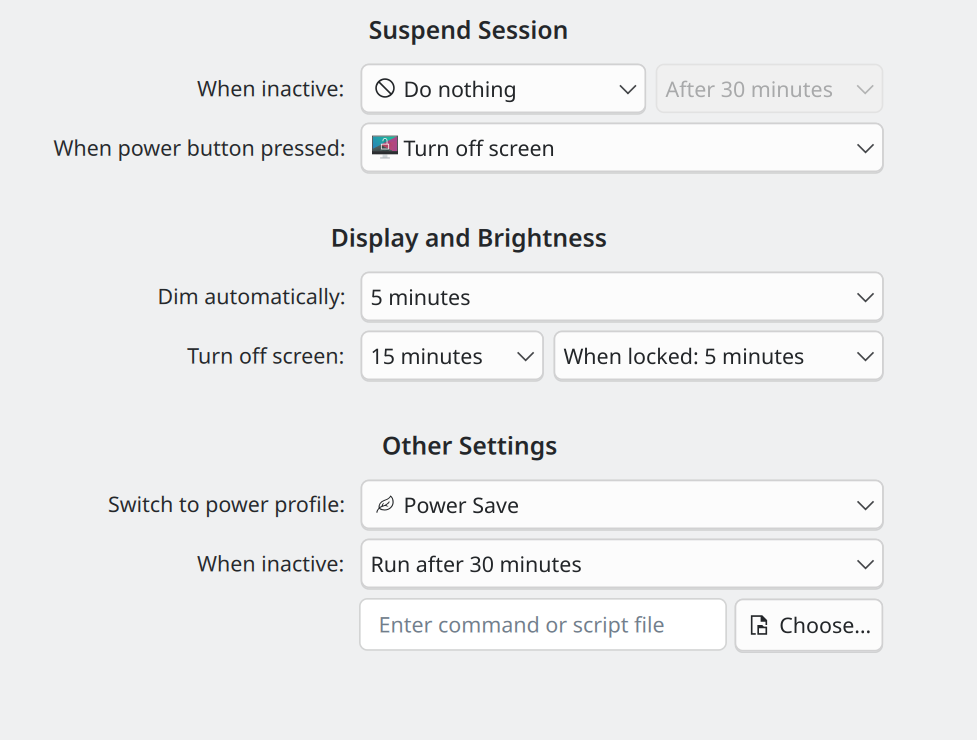
My remaining challenges on Fedora are mainly power management. Sometimes USB devices won't work when waking from sleep and sometimes the whole system refuses to wake after sleeps and needs to be power-cycled. "Screen off but don't sleep" doesn't seem to work either. Any help on this issue is appreciated.
KDE or GNOME? You used to use KDE, I think. I only use GNOME. Where is "Screen off but don't sleep" setting? Fedora desktop (not server) goes to sleep after some minutes of inactivity. Unfortunately, only desktop input events are considered activity. This is somehow mandated by EU regulations. Changing the setting for you desktop screen is easy.but changing the settings for GDM (the login screen) is more arcane. Here's the command I use. It affects all users and GDM. for i in gdm $( ls /home | grep -v 'lost+found' ) do echo $i: sudo -u "$i" dbus-run-session gsettings set org.gnome.settings-daemon.plugins.power sleep-inactive-ac-type nothing done I have a little "mouse jiggler" USB device that I can use when I want to suppress blanking (rare).
On Fri, Aug 22, 2025 at 2:34 AM D. Hugh Redelmeier via Talk < talk@lists.gtalug.org> wrote:
Bazzite is known for improved and streamlined Nvidia support, which does nothing for me on this all-AMD rig. It's also primarily aimed at being primarily a games system and secondarily anything else; I can and have installed Steam under Fedora, but to me that's Just Another Repository rather than the OS's main reason for existing. Games that work on the Steamdeck Just Work on Fedora too.
Steamdecks use AMD APU's. So AMD support ought to be good. But they have iGPUs that are a few generations behind that in your box.
No matter. In Fedora everything is as up-to-date as I need, whether in its kernel version, Vulkan or ROCm. I was warned ROCm in particular would be a pain to install (curl, unpack, scripts) but in Fedora it's just "*dnf install rocm*".
Annoying. I tend to only boot every couple of weeks -- when I feel the urge to do updates -- so slow boots would not be a veto.
Fedora updates system files weekly. Between them and the system's problem with sleeping, I find I'm rebooting far more often than I'm used to. Fedora does have flatpaks. I think that they are slightly better, but pretty
similar.
Three big differences: 1. The snap architecture is single-sourced from Canonical. I know that flathub is the default location but it's not a single point of failure as snaps are 2. Ubuntu depends way more than other distros on the snap/flatpak/appimage model. As in, last time I checked not a single browser was available for Ubuntu as a normal .deb install. I personally consider a browser to be so heavily used as to be part of the system software and should be a native package. In Fedora that is the case. While the community offers a repository of Firefox as a .deb package, the process to both set that up and disable the Firefox snap in Ubuntu is a royal PITA that I no longer need to deal with 3. There are no server flatpaks of which I am aware. Ubuntu server uses snaps. Why? One annoyance: "sudo dnf update" won't update them. You can use
"gnome software" gui updater or you can use "flatpak update"
The KDE "discover" app helps update them both.
KDE or GNOME? You used to use KDE, I think. I only use GNOME.
Still on KDE ... though something more lightweight has appeal. I have asked in another thread about Hyprland. Where is "Screen off but don't sleep" setting?
In the KDE power management settings. Screenshot attached. - Evan
Evan Leibovitch wrote on 2025-08-21 09:28:
"Run `systemd-analyze blame`"
I'll be honest, that's one of my favourite commands. D. Hugh Redelmeier via Talk wrote on 2025-08-21 23:33:
This command is great. The old init systems didn't have such useful instrumentation.
I might be late to reply, so thank you for pointing out this was not possible in the past. I just ran it on a few machines, it's nice to see <10s for the longest service to start (postfix). On my desktop, almost 50s for "plocate-updatedb", 44.5s for fsck, etc. At least systemd runs them asynchronously, so it's not noticeable.
participants (9)
-
 Alvin Starr
 -
 bitmap
 -
 CAREY SCHUG
 -
 D. Hugh Redelmeier
 -
 Evan Leibovitch
 -
 Lennart Sorensen
 -
 Ron
Ron -
 Steve Litt
 -
 William Park